Affiliate disclosure: Fast Gel is an independent LactiGo affiliate. We may earn a commission if you purchase LactiGo through links on this page, at no additional cost to you. Our goal in this article is to accurately summarize the available research and clearly separate study findings from marketing claims.
If you've seen LactiGo online, heard an athlete talk about it or come across claims about topical carnosine, you may have the same question many people have before buying: Does LactiGo actually work?
There is now peer-reviewed human research involving the product, which makes that question easier to answer than it once was. But the answer still requires some nuance.
A 2025 study published in the Journal of the International Society of Sports Nutrition tested LactiGo topical carnosine gel against a placebo in seven world-class rugby sevens players. The researchers found significantly higher peak power during three of the repeated sprints after the athletes used the topical carnosine gel. However, the study was small. It did not show a treatment effect for mean power, heart rate or perceived exertion. And it did not prove that topical LactiGo increases muscle carnosine concentrations.
So the most accurate answer is: LactiGo has promising peer-reviewed human performance evidence, particularly for peak power during repeated high-intensity exercise, but the research is still early and does not justify saying that LactiGo is guaranteed to improve performance for every athlete.
This guide breaks down exactly what the research found, what it didn't find, how the study was conducted and what that means if you're considering trying LactiGo. For the broader product overview, see our LactiGo topical carnosine gel guide.
Quick Answer: Does LactiGo Work?
There is peer-reviewed evidence showing a performance effect under specific testing conditions. In the 2025 LactiGo study:
- Seven world-class male rugby sevens players participated.
- Researchers used a counterbalanced crossover design.
- The study was triple-blind.
- LactiGo was compared with a placebo gel.
- The gel was applied 40 minutes before exercise.
- Athletes completed 12 repeated cycling sprints.
- Peak power was significantly higher with LactiGo during Sprints 2, 4 and 7.
- Mean power did not show a treatment effect.
- Heart rate did not show a treatment effect.
- Perceived exertion did not show a treatment effect.
That is legitimate evidence of an effect in the population and exercise protocol tested. It is not evidence that every person will experience the same result.
What the Research Found
- Study
- 7 world-class male rugby sevens players
- Design
- Triple-blind, crossover, placebo-controlled
- Timing
- Topical gel applied about 40 minutes before testing
- Test
- 12 intermittent maximal cycling sprints
Significant peak-power differences
Sprint 2: + approx. 101 W · Sprint 4: + approx. 103 W · Sprint 7: + approx. 156 W
No treatment effect: Mean power, heart rate, perceived exertion
Key limitation: Small sample of seven elite male athletes
Want to Try LactiGo Yourself?
See current LactiGo formulas, pricing and availability.
What Is LactiGo?
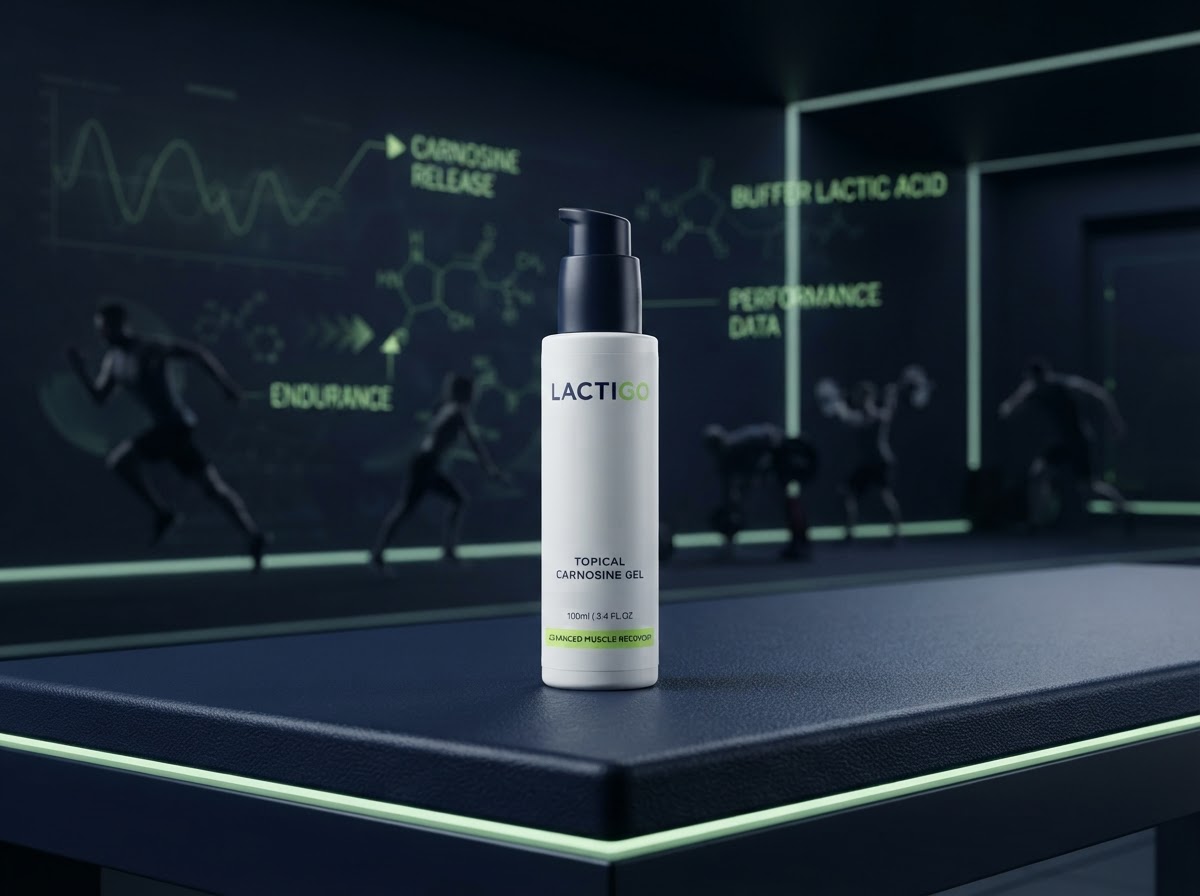
LactiGo is a topical performance and recovery gel built around carnosine and magnesium. Rather than swallowing a powder, capsule or drink, LactiGo is applied to the skin.
Different LactiGo formulas exist. The current U.S. LactiGo with Menthol label lists:
Active ingredient: Menthol 1.5%
Inactive ingredients including:
- L-carnosine
- Magnesium sulfate
- Ethoxydiglycol
- Glycerin
- Phenoxyethanol
- Water
- Xanthan gum
The current U.S. menthol formulation is listed in DailyMed as a topical analgesic for temporary relief of minor muscle and joint aches and pains. LactiGo also markets the product toward athletic performance and recovery. Those are separate contexts and should not be mixed together carelessly.
Source: U.S. National Library of Medicine DailyMed. LactiGo with Menthol Performance & Recovery Gel. Current NDC: 72481-102. Label revised March 25, 2026.
Has LactiGo Actually Been Studied?
Yes. A peer-reviewed study published in 2025 specifically identified LactiGo as the topical carnosine gel used in the experiment. The study was titled "Topical carnosine gel improves intermittent high-intensity exercise performance in world-class rugby sevens players."
It was published in the Journal of the International Society of Sports Nutrition. Authors: C. Martyn Beaven, Carl James, Daniel T. McMaster, Nic Brockelbank. DOI: 10.1080/15502783.2025.2550311. PubMed PMID: 40859880.
The research is particularly notable because the athletes were not simply recreational gym users. They were seven world-class male rugby sevens players with extensive international competition experience.
How Was the LactiGo Study Designed?
The study used a counterbalanced design, crossover design, triple-blind protocol and placebo condition. Each athlete completed both conditions at separate testing sessions. In one condition they received the topical carnosine gel. In the other they received a placebo ultrasound gel.
Importantly, menthol was added to the placebo to help mimic the sensory characteristics of the active product. That matters because if one product created an obvious sensation and the placebo did not, participants might have been able to guess which treatment they received. The authors reported successful blinding. In fact, several athletes believed they had performed better during the placebo condition. That makes the study more useful than an unblinded testimonial or simple before-and-after comparison.
What Exactly Did the Athletes Do?
The athletes applied the topical carnosine gel approximately 40 minutes before the performance test. The published methods describe a 10 mL topical gel application before the repeated-sprint protocol. They then completed 12 intermittent cycling sprints. Each sequence involved 24 seconds of cycling at 3 W/kg, followed by 6 seconds of maximal sprinting, followed by 30 seconds of recovery. There was also a two-minute break after Sprint 6.
Researchers measured peak power, mean power, heart rate and rating of perceived exertion. This type of protocol was designed to simulate repeated high-intensity work rather than one isolated endurance event.
What Did the LactiGo Study Find?
The clearest finding involved peak power. Peak power was significantly higher after the topical carnosine gel during three of the 12 sprints.
| Sprint | LactiGo / Topical Carnosine | Placebo | Approx. Difference |
|---|---|---|---|
| Sprint 2 | 1,433 W | 1,332 W | +101 W |
| Sprint 4 | 1,347 W | 1,244 W | +103 W |
| Sprint 7 | 1,426 W | 1,270 W | +156 W |
Values are rounded from the published study. These results describe the seven elite male rugby sevens players and repeated-sprint protocol tested and should not be interpreted as guaranteed results for every LactiGo user.
See the Product Used in the Research
The published 2025 study identified LactiGo as the topical carnosine gel used in the trial.
What Did the Study NOT Find?
This section is extremely important for credibility. The study did NOT report a statistically significant treatment effect for mean power, heart rate or rating of perceived exertion. Therefore, do not write "LactiGo improved every performance measurement." It did not. The strongest finding was related to peak power. This is why phrases like "clinically proven to improve all athletic performance" would go beyond the evidence.
Why Does Peak Power Matter?
Peak power reflects the highest power output reached during a sprint or explosive effort. That can be relevant in sports involving repeated high-intensity bursts, including activities such as rugby, hockey, football, basketball, combat sports, sprint cycling and certain interval-training formats.
However, the LactiGo study did not directly test all of those sports. The study tested world-class rugby sevens players using repeated maximal cycling sprints. Therefore, other sports may be plausible applications to investigate, but do not claim the study directly proved benefits in every sport listed above.
Was This Really LactiGo?
Yes. The published methods identify the carnosine gel used in the study as LactiGo, manufactured by Outplay Inc. Do not turn that into a broader claim that every LactiGo formulation currently sold is identical to every formulation ever tested. Products and formulations can change. When discussing a current product, verify the current ingredient label.
Was the Study Independent?
The publication states that the work was supported by Hong Kong Baptist University and reports no potential conflict of interest from the authors. Do not embellish this into "completely independent proof beyond any possible bias." Simply state the documented funding and conflict disclosure accurately.
Strengths and Limitations
The study has meaningful strengths: triple blinding, a placebo comparison, a crossover design (each athlete served as his own comparison), and an elite athlete population where additional improvements are hard to demonstrate. But it also has important limitations: only seven athletes (a small sample), all participants were male, elite rugby players are not everybody, and the specific exercise protocol did not directly test marathon performance, one-rep-max strength, long-distance cycling, general soreness, injury prevention or muscle growth.
Does LactiGo Increase Muscle Carnosine?
This is one of the most important unanswered questions. Carnosine is naturally found in skeletal muscle and participates in muscle physiology, including intracellular buffering. One established way of increasing muscle carnosine is chronic oral beta-alanine supplementation. LactiGo uses a different strategy: topical carnosine.
However, the 2025 LactiGo study did NOT directly establish that topical LactiGo increases intramuscular carnosine concentrations. The study authors specifically called for future research to examine this. Therefore, do not write "LactiGo has been proven to deliver carnosine directly into your muscle" or "LactiGo raises muscle carnosine in 40 minutes." Those claims are not established by this study.
If a reader wants a detailed comparison between the topical and oral approaches, read our LactiGo vs beta-alanine breakdown. For complete application instructions, see our how to use LactiGo guide.
Want to add LactiGo to your next training session?
Does LactiGo Require a Loading Phase?
LactiGo is not used like traditional beta-alanine supplementation. Beta-alanine is commonly consumed daily over multiple weeks to increase skeletal-muscle carnosine concentrations. LactiGo is applied around individual training sessions. The 2025 study evaluated an acute application rather than requiring participants to complete a multi-week LactiGo loading protocol. That is a meaningful convenience difference. But again, do not state that LactiGo produces the same physiological adaptation as several weeks of beta-alanine. The approaches are different.
Is LactiGo Just Menthol?
No. This is worth clarifying because a menthol-containing formulation can create a noticeable cooling sensation. The placebo used in the 2025 research also contained menthol to help mimic the active product. Therefore, the researchers attempted to control for the sensory effect of menthol rather than simply comparing a cooling gel against a completely sensation-free placebo. That makes it harder to dismiss the peak-power results as nothing more than athletes feeling menthol on their skin. Do not claim this proves the precise mechanism behind the performance difference. The researchers themselves stated that more mechanistic research is needed.
What About LactiGo Recovery Claims?
Be especially careful here. LactiGo is marketed for performance and recovery. The U.S. LactiGo with Menthol label also identifies menthol as a topical analgesic for temporary relief of certain minor muscle and joint aches and pains. Those facts should not be turned into unsupported claims such as "LactiGo prevents DOMS" or "LactiGo cuts recovery time in half." If discussing athletic recovery, clearly separate manufacturer positioning, OTC label indications and direct peer-reviewed performance evidence. Do not pretend the repeated-sprint study directly measured every recovery claim.
Does LactiGo Cause Side Effects?
In the 2025 repeated-sprint trial, the researchers reported that no side effects such as paresthesia were reported during either testing session. That does not mean no person could ever react to the product. For LactiGo with Menthol, current U.S. label warnings include: for external use only; do not use on wounds or irritated/damaged skin; do not use with a heating pad; avoid the eyes and mucous membranes; do not bandage tightly; stop use and seek appropriate guidance if significant irritation or certain persistent symptoms occur. Use the current DailyMed label for the complete warning language. Do not rewrite this article as individualized medical advice.
Is LactiGo Legit?
If by "legit" you mean "Is LactiGo a real product that has actually been evaluated in published human performance research?" — Yes. A peer-reviewed 2025 study specifically identified LactiGo as the topical carnosine gel tested against placebo.
If by "legit" you mean "Has LactiGo been conclusively proven to improve every kind of exercise for everybody?" — No. That claim would be much stronger than the available evidence.
A better description is: LactiGo is a real topical carnosine product with promising peer-reviewed human performance evidence, but additional studies in larger and more diverse populations are still needed.
Is LactiGo Worth Trying?
That comes down to what you expect from it. LactiGo may be worth considering if you: participate in high-intensity training; are interested in topical rather than oral performance products; do not want a traditional multi-week beta-alanine loading routine; want a product that has direct peer-reviewed human performance research; understand that individual results can vary; and are comfortable with the current research being promising rather than exhaustive.
It may be less compelling if you expect guaranteed results, a replacement for training, a proven treatment for injury, a magic solution for every form of fatigue, or a product with hundreds of independent clinical trials. The evidence should set realistic expectations.
Interested in the Topical Carnosine Approach?
Explore current LactiGo product options and choose the formula that fits your routine.
LactiGo vs Beta-Alanine
Beta-alanine has a substantially larger research base. Beta-alanine is consumed orally over time and has established evidence for increasing muscle carnosine concentrations. LactiGo provides topical carnosine and is applied around activity. They are related through carnosine biology, but they are not the same intervention. For the complete breakdown, read our LactiGo vs Beta-Alanine comparison.
LactiGo vs PR Lotion
PR Lotion is another topical performance product, but its primary performance-focused ingredient is sodium bicarbonate rather than carnosine. The two products therefore use different ingredients and proposed approaches. For the full research comparison, read our LactiGo vs PR Lotion breakdown.
What Would Make the LactiGo Evidence Stronger?
More research. Specifically, future studies could help answer: Does topical LactiGo increase intramuscular carnosine? Does it produce similar effects in women? Does it produce similar effects in recreational athletes? Which sports or exercise protocols benefit most? What is the optimal topical dose and timing? How consistent are results across larger groups? How much do individual responses vary? What mechanisms explain the acute peak-power effects? Acknowledging unanswered questions does not make the existing research worthless. It simply keeps the interpretation proportional to the evidence.
So, Does LactiGo Really Work?
The most evidence-based answer is: Under the conditions tested, LactiGo's topical carnosine gel produced significantly higher peak power during several repeated sprints in seven world-class male rugby sevens players compared with placebo. That is a meaningful result. But the same study did not find a treatment effect for every outcome, involved only seven athletes and did not establish whether LactiGo increases intramuscular carnosine.
So this is not a case where the evidence supports saying "LactiGo definitely works for everyone." It supports saying: LactiGo has promising direct human performance evidence and is a legitimate topical carnosine product worth investigating for people interested in high-intensity performance support. If that approach fits what you're looking for, use the button below to see current LactiGo formulas, pricing and availability.
Ready to Try LactiGo?
See current formulas, pricing and availability through Fast Gel.
Purchases through Fast Gel may earn us a commission at no additional cost to you.
Frequently Asked Questions About LactiGo
Sources & Further Reading
- Beaven CM, James C, McMaster DT, Brockelbank N. Topical carnosine gel improves intermittent high-intensity exercise performance in world-class rugby sevens players. Journal of the International Society of Sports Nutrition. 2025;22(1):2550311. DOI: 10.1080/15502783.2025.2550311.
- U.S. National Library of Medicine. DailyMed. LactiGo with Menthol Performance & Recovery Gel. NDC: 72481-102. Current label revised: March 25, 2026.
- Current official LactiGo product instructions.