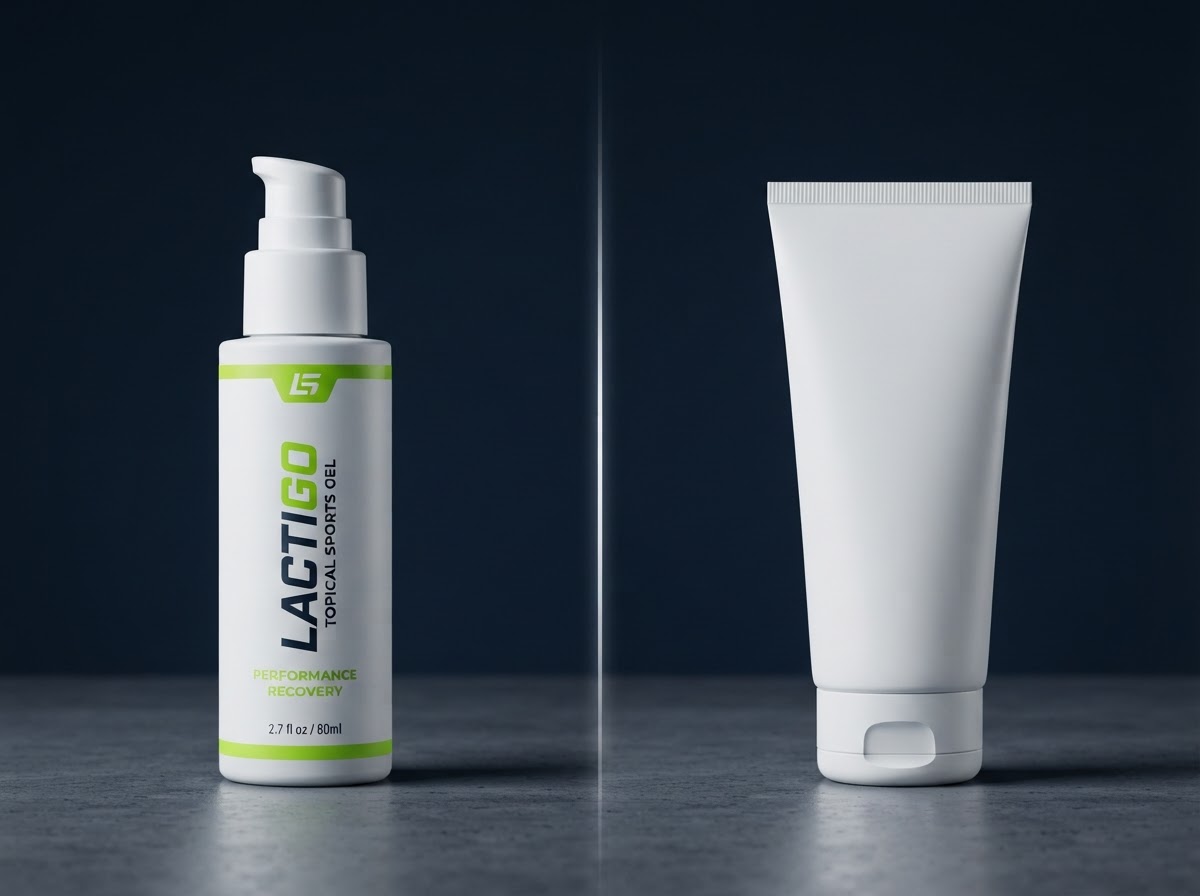
Affiliate disclosure: Fast Gel is an independent LactiGo affiliate. We may earn a commission if you purchase LactiGo through links on this page, at no additional cost to you. We do not receive compensation from PR Lotion for this comparison.
If you're comparing LactiGo vs PR Lotion, you've probably already discovered that both products are topical performance products used by athletes before demanding training or competition.
But they are not the same product.
The biggest difference is what each formula is built around. LactiGo uses a topical carnosine-based formula. PR Lotion uses topical sodium bicarbonate. Those ingredients have different histories in exercise science, different proposed mechanisms, different application instructions and very different bodies of research.
So rather than asking whether one bottle simply "beats" the other, the more useful questions are: What does each product contain? How are they used? What does the published research actually show? How strong is that evidence? Which approach better fits what you're looking for? Here's the evidence-based comparison. For a full product overview, see our introduction to LactiGo topical carnosine gel.
Quick Answer: LactiGo vs PR Lotion
LactiGo and PR Lotion are both topical products marketed toward athletes, but LactiGo is built around carnosine while PR Lotion is built around sodium bicarbonate.
Current LactiGo instructions recommend applying the gel to clean, dry skin approximately 30–45 minutes before physical activity. PR Lotion's current manufacturer directions recommend applying it liberally to working muscles at least 30 minutes before activity.
The published evidence is still developing for both topical approaches. A 2025 pilot study involving seven world-class male rugby sevens players found higher peak power during several repeated sprints after application of a topical carnosine gel compared with placebo, although mean power, heart rate and perceived exertion did not show a treatment effect. PR Lotion has been studied more often, but its findings are mixed. Some research has reported changes in muscle pH or repeated-sprint performance, while other controlled trials have not found improved buffering or performance compared with placebo.
That makes this a more nuanced comparison than simply saying one product is "proven" and the other does not work.
Interested in the Carnosine Approach?
See current LactiGo formulas, pricing and availability.
LactiGo vs PR Lotion at a Glance
| Feature | LactiGo | PR Lotion |
|---|---|---|
| Product type | Topical performance gel | Topical performance lotion |
| Primary performance ingredient | Carnosine | Sodium bicarbonate |
| Other notable ingredient | Magnesium sulfate | N/A for comparison purposes |
| Typical pre-activity timing | Approximately 30–45 minutes (current LactiGo directions) | At least 30 minutes (current Momentous directions) |
| Oral loading required | No | No |
| Applied to working areas | Yes | Yes |
| Published human research on topical approach | Yes, currently limited | Yes, multiple studies with mixed findings |
| Primary difference | Carnosine-based topical approach | Bicarbonate-based topical approach |
Formulas, certifications, prices and manufacturer instructions can change. Always check the current product label and official manufacturer instructions before use.
What Is LactiGo?
LactiGo is a topical gel formulated around carnosine and magnesium. The current regular LactiGo formula lists: Water, Glycerin, Carnosine, Magnesium sulfate, Ethoxydiglycol, Phenoxyethanol, Xanthan gum, Caprylyl glycol, Sorbic acid. LactiGo also offers other formulations, including a menthol version, so consumers should check the exact product they are purchasing rather than assuming every LactiGo formula is identical.
Unlike oral beta-alanine products, LactiGo is applied directly to the skin. Current LactiGo directions recommend applying it to clean, dry skin approximately 30–45 minutes before physical activity and massaging enough gel over the desired area to cover it. For a complete application walkthrough, see our guide on how to use LactiGo.
One reason LactiGo has attracted attention is its use of carnosine. Carnosine is a naturally occurring dipeptide made from beta-alanine and histidine and is present in skeletal muscle. Muscle carnosine has an established role in acid-base buffering physiology, which is one reason beta-alanine supplementation has been extensively researched in sports nutrition. However, oral beta-alanine supplementation and topical carnosine application should not be treated as identical interventions. For that comparison, read our LactiGo vs beta-alanine breakdown.
Want to Try LactiGo?
Explore the current LactiGo lineup and choose the formulation that fits your training routine.
What Is PR Lotion?
PR Lotion is a topical sports lotion currently sold by Momentous and originally developed by Amp Human. Its primary performance-focused ingredient is sodium bicarbonate.
Sodium bicarbonate has a long history in sports nutrition. When consumed orally in appropriate protocols, bicarbonate can increase extracellular buffering capacity, and oral sodium bicarbonate has substantial research supporting benefits in certain types of high-intensity exercise. PR Lotion takes a different approach by applying sodium bicarbonate topically rather than requiring it to be swallowed.
According to current Momentous instructions, PR Lotion should be applied liberally to the working muscle groups at least 30 minutes before training or competition. Momentous currently states that the absorbed effect can last several hours. That is a manufacturer claim and should be identified as such rather than presented as an independently proven duration for every athlete. Current Momentous directions also recommend applying PR Lotion before other topical products.
Carnosine vs Sodium Bicarbonate: What's the Difference?
This is the central difference between LactiGo and PR Lotion.
Carnosine
Carnosine exists naturally inside skeletal muscle. Among its physiological roles, carnosine can contribute to intracellular buffering. "Intracellular" means inside the muscle cell. Beta-alanine supplementation is well established as a method for increasing muscle carnosine over time, but LactiGo uses topical carnosine rather than oral beta-alanine. Researchers are now beginning to investigate whether an acutely applied topical carnosine gel can influence exercise performance.
Sodium Bicarbonate
Bicarbonate primarily functions as an extracellular buffer. "Extracellular" means outside the muscle cells, including in the blood. Oral sodium bicarbonate supplementation has been studied for decades. The challenge being investigated with PR Lotion is different: Can meaningful bicarbonate-related effects be achieved through topical application? Researchers have produced mixed findings so far.
Important: Lactate Is Not Simply "The Bad Guy"
Do not describe either product as something that simply "removes lactic acid." Modern exercise physiology does not support the simplistic idea that lactate itself is merely a waste product responsible for muscle fatigue. During intense exercise, multiple physiological processes contribute to declining performance. Hydrogen-ion accumulation and changes in muscle acid-base balance are part of that much more complicated picture. Both carnosine and bicarbonate are discussed in buffering research, but their roles and locations differ.
What Does the Research Say About Topical Carnosine?
The most relevant current human performance study was published in 2025 in the Journal of the International Society of Sports Nutrition. Researchers studied seven world-class male rugby sevens players using a counterbalanced, crossover, triple-blind design. Participants applied either 10 mL topical carnosine gel or a placebo ultrasound gel 40 minutes before completing 12 intermittent cycling sprints.
Peak power was higher with the carnosine gel during Sprints 2, 4 and 7. However, there was no treatment effect for mean power, heart rate or rating of perceived exertion. The researchers concluded that topical carnosine gel improved power production under the conditions tested.
But an important limitation deserves just as much attention: Only seven athletes participated. And the researchers specifically stated that future research should determine whether carnosine gels actually increase intramuscular carnosine concentrations. That means this study provides promising preliminary performance evidence, but it should not be presented as proof that topical carnosine works identically for every athlete or that the mechanism has been conclusively established. Read the study on PubMed.
What Does the Research Say About PR Lotion?
PR Lotion has a larger published research history than topical carnosine, but the results are mixed. That distinction is important.
2020 Controlled Study
A 2020 study published in the International Journal of Sports Physiology and Performance examined topical sodium bicarbonate using PR Lotion. The researchers evaluated buffering and cycling performance in two small experiments. They did not find meaningful improvements in blood buffering or exercise performance from PR Lotion under the conditions tested. Read the study on PubMed. It was one study using specific protocols and populations, and should not be exaggerated into a claim that PR Lotion "does not work."
2023 Team-Sport Study
A separate randomized crossover study involving 14 recreationally trained male team-sport athletes compared oral sodium bicarbonate, topical PR Lotion and placebo. The topical PR Lotion condition produced an approximately 2% faster total completion time during an 8 × 25-meter repeated-sprint test compared with placebo. However, PR Lotion did not significantly improve Yo-Yo IR2 distance compared with placebo, and researchers did not observe the same changes in blood acid-base balance that occurred with oral bicarbonate. The authors concluded that additional research was needed to determine the mechanism behind the repeated-sprint result. Read the study on PubMed.
2023 Muscle-pH Study
Another study investigated PR Lotion under resting conditions. Nine participants received a substantial topical application to the legs while researchers measured intramuscular dialysate pH. The study reported an increase in intramuscular pH following application. However, this was primarily a mechanistic resting study rather than a direct demonstration of improved athletic performance. Read the study on PubMed.
2024 Soccer Study
A 2024 randomized crossover study compared oral sodium bicarbonate, topical sodium bicarbonate using PR Lotion and placebo during simulated soccer exercise. Oral bicarbonate improved repeated sprint performance. Topical sodium bicarbonate did not produce the same repeated-sprint performance benefit. Some blood chemistry differences were observed in the topical condition, but the authors concluded that oral bicarbonate was more effective for improving buffering capacity and repeated-sprint performance in the tested soccer protocol. Read the study on PubMed. This study favored oral bicarbonate over the topical bicarbonate condition for the main performance outcome tested.
So Does PR Lotion Work?
The most accurate answer is: The research is mixed. Some controlled studies have reported potentially useful physiological or performance effects. Others have not shown meaningful improvements over placebo. That is different from saying either "PR Lotion definitely works" or "PR Lotion definitely does nothing." The topical bicarbonate literature is still developing. That nuance is important because sodium bicarbonate itself has strong evidence in sports nutrition when taken orally, but evidence supporting oral bicarbonate cannot automatically be transferred to a topical formulation.
Does LactiGo Have Better Research?
Not necessarily "more" research. PR Lotion currently has a larger body of published topical research. LactiGo's topical carnosine approach currently has less direct human performance research. However, the 2025 topical carnosine pilot is notable because it reported higher peak power during multiple repeated sprints compared with placebo in world-class rugby sevens players.
The responsible interpretation is: LactiGo/topical carnosine has promising early human performance evidence. PR Lotion/topical bicarbonate has a larger but mixed body of published evidence. Neither evidence base justifies telling every athlete that results are guaranteed.
Want to test the carnosine approach for yourself?
Shop LactiGo through Fast Gel and add it to your next training session.
Application: LactiGo vs PR Lotion
Both products are topical, so neither requires swallowing a large oral dose immediately before exercise. But their instructions differ slightly.
LactiGo
Current regular LactiGo directions recommend:
- Start with clean, dry skin.
- Apply enough product to cover the desired target area.
- Massage until absorbed.
- For pre-activity use, apply approximately 30–45 minutes before exercise.
For detailed instructions, see our guide on How to Use LactiGo.
PR Lotion
Current Momentous instructions recommend:
- Apply liberally to working muscle groups.
- Apply at least 30 minutes before activity.
- Rub thoroughly until absorbed.
- Allow PR Lotion to absorb before applying other topical products.
Momentous currently advises adjusting the amount based partly on body size. Do not copy outdated PR Lotion instructions if current manufacturer directions change.
Texture and Convenience
Texture preference is subjective. LactiGo's current manufacturer describes its gel as fast-absorbing and non-sticky. PR Lotion is a thicker lotion and its own current usage guidance recommends a generous application. The factual difference: LactiGo uses a gel format. PR Lotion uses a lotion format. Which someone prefers is largely personal.
LactiGo vs PR Lotion: Which Fits Your Training?
LactiGo May Make More Sense If You Want:
- A topical carnosine-based product
- A gel rather than a heavier lotion
- Approximately 30–45 minute pre-activity application
- Nothing to ingest
- A product centered around carnosine and magnesium
- A topical approach with promising recent human repeated-sprint research
- An alternative to bicarbonate-based topical products
PR Lotion May Make More Sense If You Want:
- A sodium bicarbonate-based topical
- A product with a longer history of published topical studies
- A bicarbonate approach without taking a large oral bicarbonate dose
- A lotion rather than a gel
- A product you've already used successfully
There is no universally correct choice because the products use different ingredients and the topical research is still developing. For Fast-Gel readers specifically looking for a PR Lotion alternative built around carnosine rather than bicarbonate, LactiGo is the more directly comparable option to investigate.
Ready to Add LactiGo to Your Routine?
LactiGo gives athletes a topical carnosine-based option that requires nothing to swallow or load orally.
What About Oral Sodium Bicarbonate?
It is important not to confuse PR Lotion research with oral bicarbonate research. Oral sodium bicarbonate has a substantial evidence base in exercise science and has demonstrated performance benefits in a number of high-intensity exercise contexts. But oral bicarbonate can also cause gastrointestinal side effects in some users. PR Lotion was developed partly around the idea of obtaining bicarbonate-related benefits without having to ingest a large sodium bicarbonate dose. Whether topical application reproduces the same physiological effects remains an active research question. Do not use positive oral bicarbonate evidence as proof that PR Lotion must work. Likewise, do not use a negative PR Lotion study to imply oral bicarbonate is ineffective. They are different delivery methods.
Can You Use LactiGo and PR Lotion Together?
There is currently no good reason for this article to recommend stacking the two products. Published studies discussed here evaluated them separately. There is not established evidence demonstrating that applying LactiGo and PR Lotion together produces better athletic performance than using either individually. Users considering combining multiple topical products should follow manufacturer directions and take skin sensitivity and other product warnings into account. Do not combine them for "maximum buffering."
What If You're Really Comparing Carnosine With Beta-Alanine?
LactiGo and PR Lotion are not the only approaches athletes use when researching buffering-related performance products. Beta-alanine is another common option. Unlike LactiGo, beta-alanine is normally consumed orally and used over time to increase muscle carnosine concentrations. If that is the comparison you're actually trying to make, read our LactiGo vs Beta-Alanine comparison.
Bottom Line: LactiGo vs PR Lotion
LactiGo and PR Lotion share one important characteristic: They're both topical products aimed at athletes who want performance support without relying entirely on something they have to swallow immediately before training. But that's where the similarity largely ends. LactiGo is built around carnosine. PR Lotion is built around sodium bicarbonate.
PR Lotion currently has the larger published topical research base, but its study results have been mixed. Topical carnosine currently has less direct human performance research, but a 2025 placebo-controlled pilot involving world-class rugby sevens players reported higher peak power in several repeated sprints after topical carnosine gel application. Neither product should be described as guaranteed to improve athletic performance for every person.
But if you're specifically looking for a topical alternative to PR Lotion and want to explore a carnosine-based approach rather than another bicarbonate product, LactiGo is worth investigating. Use the button below to see current LactiGo formulas, pricing and availability.
Try LactiGo for Your Next Training Session
See current LactiGo pricing, formulas and availability through Fast Gel.
Purchases through this link support Fast Gel at no additional cost to you.
Frequently Asked Questions About LactiGo vs PR Lotion
Sources & Further Reading
- Beaven CM, James C, McMaster DT, Brockelbank N. Topical carnosine gel improves intermittent high-intensity exercise performance in world-class rugby sevens players. Journal of the International Society of Sports Nutrition. 2025;22(1):2550311. DOI: 10.1080/15502783.2025.2550311 · PMID: 40859880
- McKay AK et al. Topical Sodium Bicarbonate: No Improvement in Blood Buffering Capacity or Exercise Performance. International Journal of Sports Physiology and Performance. 2020;15(7):1005–1011. DOI: 10.1123/ijspp.2019-0345 · PMID: 32575069
- Beneficial effects of oral and topical sodium bicarbonate during a battery of team sport-specific exercise tests in recreationally trained male athletes. PMID: 37227399
- Transcutaneous delivery of sodium bicarbonate increases intramuscular pH. PMID: 36960159
- Gurton WH et al. Oral but Not Topical Sodium Bicarbonate Improves Repeated Sprint Performance During Simulated Soccer Match Play Exercise in Collegiate Athletes. International Journal of Sport Nutrition and Exercise Metabolism. 2024. DOI: 10.1123/ijsnem.2024-0059 · PMID: 39222921
- Current LactiGo official product directions and ingredient information.
- Current Momentous PR Lotion official product directions and ingredient information.