Affiliate disclosure: Fast Gel is an independent LactiGo affiliate. We may earn a commission if you purchase LactiGo through links on this page, at no additional cost to you.
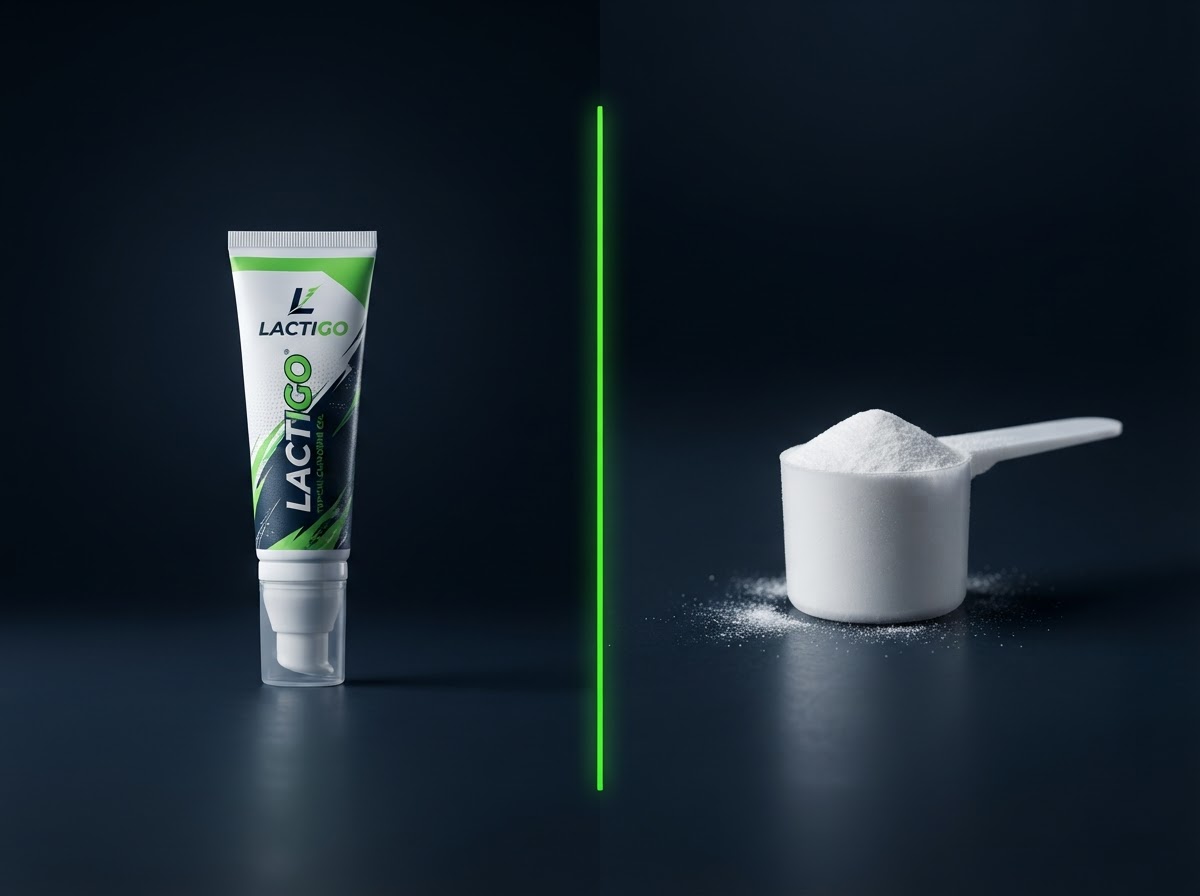
If you're comparing LactiGo vs beta-alanine, the first thing to understand is that they are not two versions of the same supplement. They take very different approaches. Beta-alanine is an amino acid you consume regularly to increase muscle carnosine over time. LactiGo is a topical carnosine-based gel applied directly to the skin around physical activity. That difference affects almost everything: how you use them, how often you use them, how long they take to fit into a performance routine, what evidence supports them, and what side effects or inconveniences they may involve. For a full product overview, see our introduction to LactiGo topical carnosine gel.
Beta-alanine has decades of research behind it and substantially more evidence than topical carnosine. LactiGo offers something different: a topical approach that does not require swallowing a supplement or completing a traditional multi-week beta-alanine loading protocol. So the useful question is not simply "Which one is better?" It is: Which approach makes more sense for what you are trying to accomplish?
Quick Answer: LactiGo vs Beta-Alanine
Beta-alanine is taken orally and generally needs to be consumed consistently for several weeks to meaningfully increase muscle carnosine. A widely cited International Society of Sports Nutrition position stand concluded that approximately 4–6 grams of beta-alanine per day for at least 2–4 weeks can increase muscle carnosine and may improve certain types of high-intensity exercise performance.
LactiGo takes a different approach. Instead of supplying beta-alanine as a precursor, LactiGo contains carnosine itself in a topical gel. Current LactiGo directions recommend applying it to clean, dry skin approximately 30–45 minutes before physical activity. A 2025 pilot study involving seven world-class rugby sevens players reported higher peak power in several repeated sprints after topical carnosine gel compared with placebo.
However, topical carnosine currently has far less research than oral beta-alanine, and the researchers specifically said further research is needed to determine whether topical carnosine increases intramuscular carnosine concentrations. Therefore: Beta-alanine has the more established long-term supplementation evidence. LactiGo provides a substantially different topical, activity-based approach with promising but earlier-stage direct research.
Prefer a Topical Option?
LactiGo provides a carnosine-based topical option that can be incorporated around your training routine without taking a daily powder or capsule.
LactiGo vs Beta-Alanine at a Glance
| Feature | LactiGo | Beta-Alanine |
|---|---|---|
| Format | Topical gel | Oral supplement |
| Primary ingredient / approach | Carnosine-based topical formula | Beta-alanine amino acid |
| How it is used | Applied to target areas | Consumed orally |
| Typical timing | Approximately 30–45 minutes before activity (current LactiGo directions) | Taken daily over time |
| Loading period | No traditional multi-week oral loading protocol | Typically at least 2–4 weeks before meaningful muscle-carnosine increases |
| Common research dosing | Product-specific topical application | Often approximately 4–6 g/day in research |
| Relationship to carnosine | Contains carnosine | Provides beta-alanine used to synthesize carnosine |
| Research depth | Emerging direct topical research | Large established research base |
| Tingling / paresthesia | Not a beta-alanine supplement | Can occur with larger individual beta-alanine doses |
| Nothing to swallow | Yes | No |
| Direct evidence of increasing muscle carnosine | Not yet established for topical carnosine | Yes |
Research protocols and product instructions vary. This table is intended as a general comparison, not individualized medical or sports-nutrition advice.
What Is Beta-Alanine?
Beta-alanine is a nonessential amino acid and one of the most established sports-nutrition ingredients associated with increasing muscle carnosine. When beta-alanine is consumed, the body can combine it with histidine to synthesize carnosine.
Why supplement beta-alanine rather than simply taking carnosine orally? One important reason is that beta-alanine availability is considered a limiting factor in muscle carnosine synthesis. Consistent beta-alanine supplementation has repeatedly been shown to increase skeletal-muscle carnosine concentrations. Carnosine can contribute to intracellular acid-base buffering during intense muscular work. That is why beta-alanine tends to be most relevant to exercise where substantial muscular acidity develops.
How Long Does Beta-Alanine Take to Work?
Beta-alanine is not generally considered an acute "take it 30 minutes before your workout and immediately activate it" supplement. Its primary performance strategy is chronic supplementation. The International Society of Sports Nutrition position stand reported that approximately 4–6 g/day for four weeks significantly increases muscle carnosine, that research has reported performance benefits after at least 2–4 weeks of supplementation, and that benefits appear especially relevant to certain high-intensity exercise tasks. A 2024 systematic review and meta-analysis specifically examining trained young men also found an overall benefit for maximal-intensity exercise and reported significant effects in studies using four weeks of supplementation.
That is an important distinction. If someone starts beta-alanine at lunch, they should not expect the full muscle-carnosine adaptation by that afternoon's workout. Consistency over time matters more than precisely timing a single dose immediately before training. Source: Trexler ET et al., ISSN position stand (PMID 26175657) · Georgiou GD et al., 2024 meta-analysis (PMID 39032921)
How Much Beta-Alanine Is Typically Used?
Research protocols vary. The ISSN position stand commonly cites 4–6 grams per day as an evidence-supported range for increasing muscle carnosine. That does not mean everyone should automatically take a particular amount. Individual products, body size, tolerance, dietary considerations and medical circumstances vary. The purpose of this article is to compare approaches, not prescribe a personalized supplement regimen.
Why Does Beta-Alanine Cause Tingling?
Some people experience a temporary tingling sensation after beta-alanine. This is called paresthesia. It is a well-known effect of beta-alanine supplementation, particularly when relatively large amounts are taken in a single immediate-release dose. The ISSN position stand notes that paresthesia can often be reduced by dividing the total daily amount into smaller doses or using sustained-release formulations. Paresthesia is not evidence that beta-alanine has "kicked in." The more tingling you feel is not a sign it is working better.
Does Beta-Alanine Actually Improve Performance?
Beta-alanine has a much larger research base than topical carnosine. A large 2017 systematic review and meta-analysis included 40 studies, 65 exercise protocols and 1,461 participants and found a statistically significant overall effect favoring beta-alanine. The size of the effect varied depending on exercise type and duration. More recent analysis has continued to show that context matters. A 2024 meta-analysis of trained young men found an overall benefit in maximal-intensity exercise, with particularly notable findings in certain exercise-duration and dosing subgroups.
However, beta-alanine should not be described as universally improving every athletic task. Its effects depend on exercise duration, exercise modality, training status, supplement duration, dose and the outcome being measured. For example, a 2026 systematic review specifically examining repeated-sprint ability did not find clear improvements across the repeated-sprint outcomes it analyzed. That does not mean beta-alanine "doesn't work" — it means its usefulness is more specific than the broad statement "beta-alanine improves everything." Source: Saunders B et al., 2017 meta-analysis (PMID 27797728)
What Is LactiGo?
LactiGo is a topical carnosine-based performance and recovery gel. The current regular LactiGo formula lists water, glycerin, carnosine, magnesium sulfate, ethoxydiglycol, phenoxyethanol, xanthan gum, caprylyl glycol and sorbic acid. Other LactiGo formulations exist, including a menthol version, so readers should always check the exact product they are purchasing.
Unlike beta-alanine, LactiGo is not swallowed. Current regular LactiGo directions recommend: starting with clean, dry skin; applying enough gel to cover the desired area; massaging it into the skin until absorbed; and for pre-activity use applying approximately 30–45 minutes beforehand. For a complete walkthrough, see our guide on how to use LactiGo. This makes LactiGo fundamentally different from a beta-alanine loading protocol. You use beta-alanine consistently to influence muscle carnosine over time; LactiGo is used topically around activity.
Want to Try the Topical Approach?
See current LactiGo formulas, pricing and availability.
What Does the Research Say About Topical Carnosine?
A peer-reviewed study published in 2025 evaluated topical carnosine gel in seven world-class male rugby sevens players. The study used a counterbalanced, crossover, triple-blind, placebo-controlled design. Participants applied 10 mL of topical carnosine gel or a placebo ultrasound gel 40 minutes before completing a repeated-sprint cycling protocol. Researchers reported higher peak power with the topical carnosine condition during Sprints 2, 4 and 7. Mean power, heart rate and perceived exertion did not show a treatment effect. The researchers concluded that topical carnosine gel improved power production under the conditions tested.
But two limitations are extremely important: only seven athletes participated, and the study did not establish that topical application increased intramuscular carnosine. The authors specifically recommended future research examining that mechanism. This makes the study promising preliminary evidence rather than a reason to claim that topical carnosine has already accumulated the same evidence base as beta-alanine. Source: Beaven CM et al., JISSN 2025 (PMID 40859880)
The Key Difference: Carnosine vs a Carnosine Precursor
Beta-Alanine
Beta-alanine is not carnosine itself. It is one of the amino acids the body uses to synthesize carnosine. When beta-alanine is consumed consistently, it can increase muscle carnosine stores over time. That mechanism has been demonstrated repeatedly.
LactiGo
LactiGo includes carnosine itself in a topical formulation. Instead of consuming a precursor daily, the product is applied to the skin around physical activity. However, it would be scientifically inappropriate to assume that because the product contains carnosine, topical application automatically causes the same intramuscular increase established with chronic oral beta-alanine supplementation. Current research has begun testing performance outcomes with topical carnosine, but more mechanistic work is needed.
Does LactiGo Work Faster Than Beta-Alanine?
This question needs careful wording because "works" can mean different things. Beta-alanine's established strategy depends on repeated supplementation over time to increase muscle carnosine. Therefore, someone generally does not begin a beta-alanine protocol expecting maximal benefit from one single dose immediately before exercise. LactiGo, by contrast, is designed and labeled for topical use around individual activity sessions. Current LactiGo instructions recommend applying it approximately 30–45 minutes before activity, and the 2025 topical-carnosine study also used an acute application 40 minutes before exercise.
So the usage models are clearly different: beta-alanine = chronic oral supplementation and LactiGo = acute topical application around activity. That does not prove that LactiGo recreates weeks of beta-alanine adaptation in 40 minutes.
Don't want to build your routine around weeks of daily supplementation?
Explore LactiGo →Do You Have to Take Beta-Alanine Every Day?
Beta-alanine research generally uses regular daily supplementation. Because the goal is to increase muscle carnosine over time, consistency is more relevant than treating beta-alanine as an occasional pre-workout ingredient. This is also why a small amount of beta-alanine included in a pre-workout powder does not necessarily mean the user is following a research-supported loading protocol. A consumer should look at amount per serving, total daily intake, frequency of use and duration of supplementation rather than assuming the ingredient's presence on a label guarantees the same conditions used in successful studies.
Is Beta-Alanine a Stimulant?
No. Beta-alanine is not caffeine and is not considered a stimulant. It does not work by producing the same central nervous system effects as caffeine. The tingling some users experience should not be confused with stimulant activity.
Does LactiGo Contain Beta-Alanine?
The current regular LactiGo ingredient list identifies carnosine rather than beta-alanine. Therefore, LactiGo should not be described as a topical beta-alanine supplement. They are related through carnosine biology, but they are different compounds and different product strategies.
LactiGo vs Beta-Alanine for Convenience
This is where the difference becomes especially practical. A typical research-informed beta-alanine strategy involves daily oral supplementation, appropriate total daily intake, continued use for multiple weeks and potentially dividing doses to reduce tingling. Current LactiGo use involves clean, dry skin, applying the gel to the relevant areas, massaging until absorbed and applying approximately 30–45 minutes before activity. Neither approach is inherently "hard." They simply fit different routines. Someone already taking daily supplements may find beta-alanine easy to maintain. Someone who does not want another daily powder or capsule may find topical application more appealing.
LactiGo vs Beta-Alanine for Athletes
The right comparison depends heavily on the sport and goal. Beta-alanine may be particularly relevant to athletes whose training involves demanding bouts of high-intensity activity where muscle buffering may play an important role. Research has often focused on exercise lasting from roughly tens of seconds to several minutes, although exact benefits depend on the task. LactiGo may appeal to athletes who want a topical product, no oral loading routine, no beta-alanine powder or capsules, no beta-alanine paresthesia, application around specific training sessions, a carnosine-based topical product and a product that can be applied to targeted areas.
Which Has More Research?
Beta-alanine. Make this answer very clear. Beta-alanine has decades of sports-nutrition research, numerous randomized controlled studies, systematic reviews, meta-analyses and established evidence that supplementation increases muscle carnosine. Topical carnosine has a much smaller direct research base. The 2025 world-class rugby sevens study is promising, but it is an early study involving seven participants. Being transparent about this makes the comparison more credible. The reason someone may still choose LactiGo is not because beta-alanine lacks research. It may be because they prefer topical rather than oral use, an activity-based rather than daily routine, no traditional beta-alanine loading period, no beta-alanine tingling, or LactiGo's specific product format.
Which Approach Fits Your Routine?
Consider LactiGo If You Prefer:
- A topical product
- Nothing to swallow
- A product applied around activity
- No traditional multi-week loading protocol
- A carnosine-containing topical gel
- Avoiding beta-alanine-associated tingling
- A targeted application routine
Consider Beta-Alanine If You Prefer:
- A well-established oral sports supplement
- A substantially larger research base
- A strategy proven to increase muscle carnosine over time
- A daily supplementation routine
- An inexpensive commodity supplement
- A longer-term supplementation strategy
Neither approach needs to be portrayed dishonestly for this comparison to be useful. They solve different problems and fit different routines.
Add LactiGo to Your Training Routine
Explore LactiGo's topical carnosine-based formulas and current product options.
Can You Use LactiGo and Beta-Alanine Together?
There is an important distinction here. Beta-alanine is an oral supplement typically used chronically. LactiGo is a topical product used around activity. However, there is not currently enough direct research showing that combining LactiGo with beta-alanine produces a greater performance benefit than using either strategy independently. Therefore this article does not recommend a specific stacking protocol, and it does not tell readers that combining them creates "maximum carnosine loading" or "double buffering." People who use supplements or topical products together should follow product directions and discuss individualized concerns with an appropriate healthcare or sports-nutrition professional when necessary.
What About PR Lotion?
Another topical performance product readers may encounter is PR Lotion. PR Lotion uses a sodium-bicarbonate-based topical approach rather than LactiGo's carnosine-based formula. If someone is comparing topical products rather than topical versus oral supplementation, read our LactiGo vs PR Lotion comparison.
Bottom Line: LactiGo vs Beta-Alanine
Beta-alanine and LactiGo both intersect with the science of carnosine, but they are not interchangeable products. Beta-alanine is an oral precursor used consistently over time to increase muscle carnosine. LactiGo contains carnosine in a topical formula applied around physical activity.
Beta-alanine currently has the far larger research base and established evidence for increasing muscle carnosine. LactiGo offers a different experience: topical rather than oral, activity-based rather than a traditional loading routine, no beta-alanine powder or capsules, no beta-alanine paresthesia, and current instructions built around approximately 30–45 minute pre-activity application. Early human research on topical carnosine is promising, but the evidence base remains much smaller and should be described accurately.
For someone who wants the traditional, extensively studied oral approach, beta-alanine may fit that preference. For someone specifically looking for a topical carnosine-based alternative that does not require a traditional beta-alanine loading routine, LactiGo is worth exploring. Use the button below to see current LactiGo formulas, pricing and availability.
Ready to Try LactiGo?
See current LactiGo formulas, pricing and availability through Fast Gel.
Purchases through this link may earn Fast Gel a commission at no additional cost to you.
Frequently Asked Questions About LactiGo vs Beta-Alanine
Sources & Further Reading
- Trexler ET et al. International Society of Sports Nutrition position stand: Beta-Alanine. Journal of the International Society of Sports Nutrition. 2015;12:30. PMID: 26175657
- Saunders B et al. β-alanine supplementation to improve exercise capacity and performance: a systematic review and meta-analysis. PMID: 27797728
- Georgiou GD et al. Effect of Beta-Alanine Supplementation on Maximal Intensity Exercise in Trained Young Male Individuals: A Systematic Review and Meta-Analysis. International Journal of Sport Nutrition and Exercise Metabolism. 2024. PMID: 39032921
- Beaven CM, James C, McMaster DT, Brockelbank N. Topical carnosine gel improves intermittent high-intensity exercise performance in world-class rugby sevens players. Journal of the International Society of Sports Nutrition. 2025;22(1):2550311. DOI: 10.1080/15502783.2025.2550311 · PMID: 40859880
- Current official LactiGo product directions and ingredients.