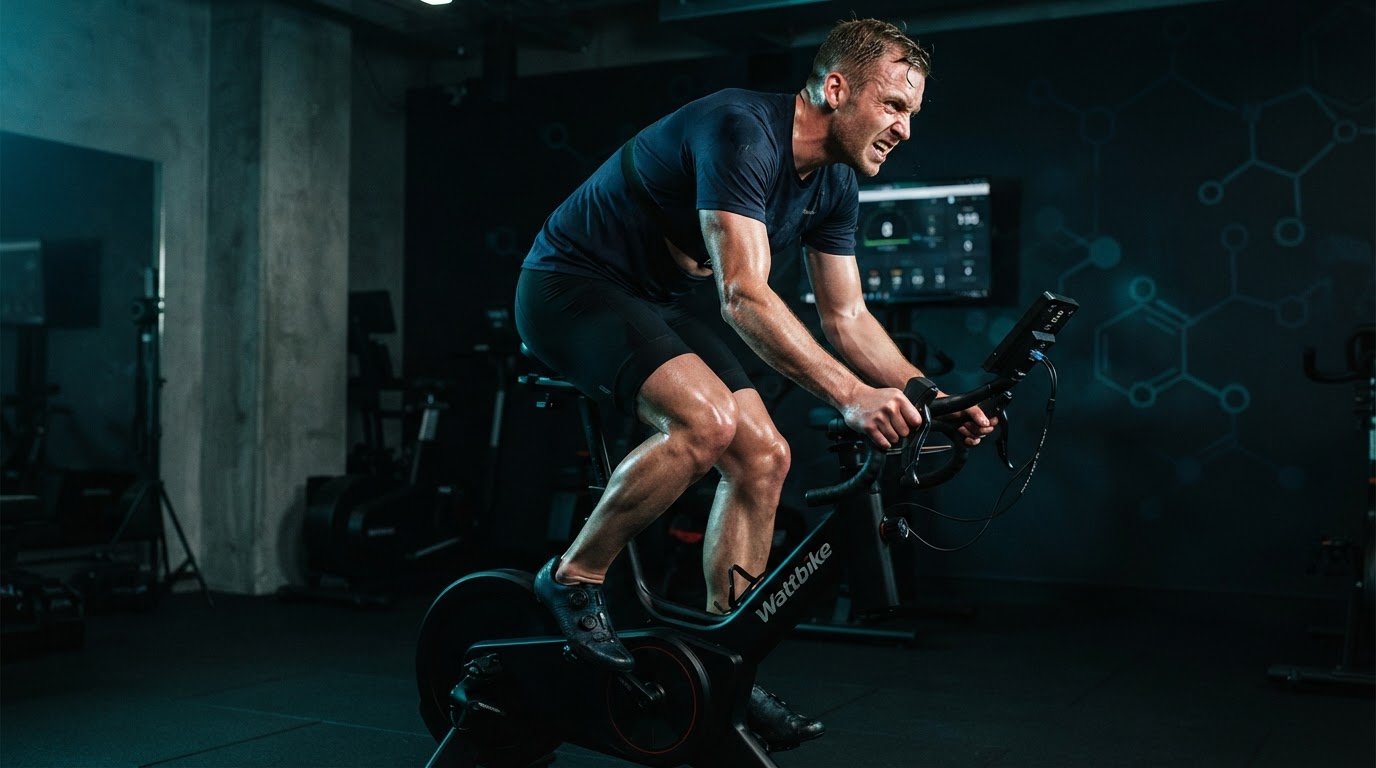
Sodium bicarbonate is better known as baking soda. But it is also one of the most heavily studied buffering agents in sports nutrition. Athletes have experimented with bicarbonate because intense exercise creates rapid changes in acid-base balance.
The basic idea is that increasing bicarbonate availability outside the muscle may help the body handle some of the chemical changes associated with demanding high-intensity exercise. That does NOT mean baking soda removes lactic acid, prevents all fatigue, works for every athlete, or improves every sport. The evidence is much more specific.
A new 2026 systematic review and meta-analysis of team-sport athletes found a small average improvement in high-intensity intermittent exercise performance after oral sodium bicarbonate. But individual responses and specific exercise outcomes varied substantially. Here's what sodium bicarbonate actually does, where the evidence is strongest and how oral bicarbonate differs from newer topical approaches.
Quick Answer: Does Sodium Bicarbonate Improve Exercise Performance?
Sometimes. A 2026 systematic review analyzed 20 randomized controlled studies involving 241 team-sport athletes and 53 performance effect sizes. Researchers found a small overall benefit for high-intensity intermittent exercise performance.
However, when specific performance categories were examined, there were no clear consistent effects for repeated-sprint performance, mean power, intermittent endurance or work capacity. The review also found that sodium bicarbonate increased blood bicarbonate, blood pH and post-exercise blood lactate. The authors concluded that practical use should be individualized according to exercise task, individual response and gastrointestinal tolerance.
Source: Effects of acute or short-term oral sodium bicarbonate supplementation on high-intensity intermittent exercise performance and physiological responses in team-sport athletes: a systematic review and meta-analysis. 2026. PMID 42781544.
Key Takeaways
- Sodium bicarbonate is an extracellular buffering agent.
- Oral bicarbonate temporarily raises blood bicarbonate and pH.
- Research suggests small average benefits for some high-intensity exercise.
- Benefits are not consistent across every exercise test or athlete.
- GI distress is one of the biggest practical limitations.
- Sodium bicarbonate contains a large amount of sodium.
- Oral bicarbonate and topical bicarbonate should not be assumed to work identically.
- PR Lotion uses topical sodium bicarbonate.
- Published PR Lotion results are mixed.
- Carnosine works primarily as an intracellular muscle buffer.
- LactiGo uses a topical carnosine-based approach rather than sodium bicarbonate.
What Is Sodium Bicarbonate?
Sodium bicarbonate is the compound NaHCO₃, commonly known as baking soda. In the body, bicarbonate participates in acid-base regulation. Blood contains bicarbonate as part of an important extracellular buffering system. This is why researchers became interested in using sodium bicarbonate before high-intensity exercise.
What Does "Buffering" Mean?
A buffer helps resist rapid changes in pH. During hard exercise, working muscles experience major metabolic and ionic changes. Hydrogen ions are produced and transported as energy turnover increases. Your body has several systems for maintaining acid-base balance. Two important exercise-related buffers are:
Carnosine
Primarily intracellular — meaning inside the muscle cell.
Bicarbonate
Primarily extracellular — meaning outside the muscle cell, including in the blood. This difference becomes important later when comparing beta-alanine, LactiGo, sodium bicarbonate and PR Lotion.
How Does Sodium Bicarbonate Work During Exercise?
Consuming sodium bicarbonate can temporarily increase blood bicarbonate concentration and blood pH. This creates a more alkaline extracellular environment. The proposed performance benefit involves supporting movement of hydrogen ions out of working muscle and helping maintain acid-base balance during demanding exercise. NIH summarizes the mechanism as increased disposal of hydrogen ions produced during intense muscular activity.
However, do NOT say "sodium bicarbonate neutralizes all muscle acid" or "bicarbonate stops fatigue." Exercise fatigue has many causes beyond acid-base balance.
Source: NIH Office of Dietary Supplements. Dietary Supplements for Exercise and Athletic Performance.
What Kind of Exercise May Benefit Most?
Research interest generally centers on high-intensity intervals, swimming, rowing, cycling, combat sports, repeated hard efforts, some team sports and short-duration intense exercise. NIH states that bicarbonate may provide a minor to moderate performance benefit during some short-term intense and intermittently intense activities. However, not every study finds a benefit, and not every athlete responds the same way.
What Does the Newest Research Show?
A 2026 systematic review gives us one of the most current summaries. Researchers included 20 studies, 241 athletes and 53 performance effect sizes in team-sport populations. The overall analysis found a small beneficial effect for high-intensity intermittent exercise. Effect size: Hedges' g = 0.23 (95% CI: 0.07 to 0.39).
However, the prediction interval crossed zero. That means future studies or individual settings could reasonably produce benefits, little effect, or no effect. The authors did not find clear effects when specifically analyzing repeated-sprint performance, mean power, intermittent endurance or work capacity. So do NOT convert the overall finding into "baking soda improves sprint performance." The evidence is more nuanced.
Source: 2026 systematic review and meta-analysis. PMID 42781544.
Why Did Blood Lactate Increase?
This can confuse readers. If lactate is supposedly "bad," why would an effective buffering strategy sometimes result in higher blood lactate? Because lactate itself is not simply toxic waste. Enhanced extracellular buffering may support continued high-intensity glycolytic work, hydrogen-ion transport and lactate transport out of muscle.
The 2026 meta-analysis found higher post-exercise blood lactate after bicarbonate supplementation along with increased bicarbonate and pH. That does NOT mean bicarbonate made athletes more fatigued. This is another reason Fast-Gel avoids simplistic "lactic acid buildup" language. For the full picture, read our Why Do Muscles Burn During Exercise? article.
Does Baking Soda Stop Muscle Burn?
Do NOT answer yes. The acute burning sensation during intense exercise involves acid-base changes, ATP-related metabolites, lactate, protons, sensory nerve signaling and multiple interacting physiological factors. Bicarbonate can affect extracellular acid-base balance. That does NOT mean it completely removes the sensation of muscle burn. Do not market bicarbonate or any related product as "the cure for muscle burn."
How Much Sodium Bicarbonate Has Been Studied?
For informational purposes only: a commonly researched acute protocol is approximately 0.3 g/kg body mass. NIH discusses this amount because it has been used extensively in performance research. However, do NOT turn this article into personalized dosing instructions. The required amount can represent a very large sodium intake. For example, NIH notes sodium bicarbonate is approximately 27.4% sodium by weight.
That makes safety and individual circumstances important. This article does not provide a calculator telling readers exactly how many grams to consume. It does not encourage readers to copy research protocols without considering medical conditions, sodium restrictions, medications, GI tolerance or professional guidance. This article explains the evidence rather than prescribing supplementation.
Why Can Sodium Bicarbonate Upset Your Stomach?
One of the biggest limitations is gastrointestinal distress. Reported issues include nausea, stomach pain, bloating, diarrhea and vomiting. NIH identifies GI distress as the main practical side effect of performance-level sodium bicarbonate intake. Individual tolerance varies substantially.
This can create an obvious problem: a supplement cannot improve athletic performance if the athlete is too nauseated to perform well. That is one reason researchers have investigated different timing strategies, different formulations, capsules, split ingestion and topical delivery. This article does not provide a detailed DIY dosing protocol.
Is Sodium Bicarbonate Safe?
Avoid a blanket "yes." Research has extensively examined short-term use in healthy adults. But performance protocols can involve substantial sodium exposure. This may be especially relevant for people with conditions or medications affected by sodium intake, fluid balance, blood pressure, acid-base balance or kidney function.
People with relevant health conditions, sodium restrictions or medication concerns should seek appropriate medical guidance before deliberately consuming large amounts of sodium bicarbonate for exercise. This article does not diagnose anyone.
Does Sodium Bicarbonate Work Better for Trained Athletes?
NIH notes that available research suggests trained athletes may be more likely to benefit in certain settings. That does not mean "untrained people cannot respond." It means effects appear context-dependent. Training status is only one factor. Other variables include exercise protocol, timing, GI tolerance, individual bicarbonate response, baseline fitness and duration/intensity.
Sodium Bicarbonate vs Beta-Alanine
Both are discussed as buffering-related sports supplements. But they work differently.
Sodium Bicarbonate
Primarily increases extracellular buffering capacity and is generally used acutely.
Beta-Alanine
Is consumed chronically so the body can increase muscle carnosine, which contributes to intracellular buffering.
| Feature | Sodium Bicarbonate | Beta-Alanine |
|---|---|---|
| Primary buffering location | Extracellular | Intracellular via carnosine |
| Typical research strategy | Acute | Chronic |
| Main physiological change | Increased blood bicarbonate/pH | Increased muscle carnosine |
| Common practical issue | GI distress / sodium load | Paresthesia |
| Evidence depth | Extensive | Extensive |
| Same mechanism? | No | No |
For the full comparison, read our LactiGo vs Beta-Alanine breakdown.
Should Beta-Alanine and Sodium Bicarbonate Be Combined?
Do NOT build a stacking recommendation. A 2024 systematic review and meta-analysis examined beta-alanine alone, sodium bicarbonate alone and their combination across 10 studies and 243 participants. In that specific analysis, the combination showed a small overall performance benefit compared with placebo, while the pooled isolated interventions did not reach statistical significance.
But those findings exist within a much larger literature where both supplements have produced positive and null results depending on the protocol. Do NOT turn this into "everyone should stack bicarbonate and beta-alanine."
Source: Curran-Bowen T et al. Sodium bicarbonate and beta-alanine supplementation: Is combining both better than either alone?. Biology of Sport. 2024.
What Is Topical Sodium Bicarbonate?
Because oral bicarbonate can create GI problems, companies have investigated topical bicarbonate. Instead of swallowing sodium bicarbonate, a lotion containing bicarbonate is applied to the skin. The best-known commercial example is PR Lotion. PR Lotion is currently sold by Momentous. Momentous instructs users to apply the lotion to working muscles at least 30 minutes before activity. This is manufacturer guidance. Keep manufacturer claims separate from independent research findings.
Does PR Lotion Work?
The research is mixed.
2020 Study
A 2020 study found that PR Lotion did not significantly increase blood bicarbonate, increase blood pH, improve peak power, improve mean power or improve cycling performance under the tested protocols.
Source: McKay AK et al. Topical Sodium Bicarbonate: No Improvement in Blood Buffering Capacity or Exercise Performance. 2020. PMID 32575069.
Team-Sport Study
A study involving 14 recreationally trained male team-sport athletes compared oral bicarbonate, PR Lotion and placebo. The oral condition improved repeated-sprint performance and Yo-Yo IR2 distance. PR Lotion produced approximately 2% faster repeated-sprint completion versus placebo. However, PR Lotion did NOT significantly improve Yo-Yo IR2 distance and did not produce the systemic acid-base changes observed with oral bicarbonate.
Source: Beneficial effects of oral and topical sodium bicarbonate during a battery of team sport-specific exercise tests. PMID 37227399.
2024 Soccer Study
A randomized study of 10 collegiate male soccer players found that oral bicarbonate improved repeated-sprint performance during simulated soccer match play. Topical PR Lotion did NOT produce the same main repeated-sprint benefit.
Source: Gurton WH et al. Oral but Not Topical Sodium Bicarbonate Improves Repeated Sprint Performance During Simulated Soccer Match Play Exercise in Collegiate Athletes. 2024. PMID 39222921.
The correct summary is: PR Lotion has legitimate human research, but results across studies are mixed. Do NOT say "PR Lotion doesn't work." Do NOT say "PR Lotion is clinically proven to work." Both would oversimplify the evidence.
Oral vs Topical Sodium Bicarbonate
| Feature | Oral Sodium Bicarbonate | Topical / PR Lotion |
|---|---|---|
| Delivery | Swallowed | Applied to skin |
| Research depth | Extensive | Smaller |
| Blood bicarbonate increase | Established | Not consistently observed |
| Blood pH increase | Established | Not consistently observed |
| GI distress | Can be substantial | Avoids swallowing bicarbonate |
| Topical application | No | Yes |
| Exercise findings | Positive and null depending on protocol | Mixed |
Why Use a Topical Product at All?
The appeal is practical. Some athletes dislike large oral bicarbonate amounts, the salty taste, capsules and GI distress. A topical product attempts to avoid the gastrointestinal route entirely. But avoiding ingestion does not automatically prove the same amount of bicarbonate reaches the same physiological compartment. That is why direct research on topical products matters.
How Is Carnosine Different From Bicarbonate?
This is an important bridge to Fast-Gel's core topic. Both carnosine and bicarbonate are discussed in buffering. But they primarily operate in different locations. Carnosine is intracellular. Bicarbonate is extracellular. Carnosine exists naturally inside skeletal muscle. It is made from beta-alanine and histidine. This is why beta-alanine supplementation can increase muscle carnosine. For the full guide, read our Carnosine Benefits article.
What Is Topical Carnosine?
A newer strategy involves applying carnosine itself in a topical formulation. This is different from PR Lotion's topical sodium-bicarbonate strategy. Human topical-carnosine research is still emerging. For the full guide, read our Topical Carnosine article.
Affiliate disclosure: Fast Gel is an independent LactiGo affiliate. We may earn a commission if you purchase LactiGo through links on this page, at no additional cost to you. LactiGo uses a different carnosine-based approach from sodium-bicarbonate products such as PR Lotion.
Where Does LactiGo Fit?
LactiGo is a topical carnosine-based gel. It is NOT topical sodium bicarbonate. Current regular LactiGo ingredients include water, glycerin, carnosine, magnesium sulfate, ethoxydiglycol, phenoxyethanol, xanthan gum, caprylyl glycol and sorbic acid. Current product instructions recommend application to clean, dry skin approximately 30–45 minutes before activity.
What Does the LactiGo Research Show?
A 2025 study tested topical carnosine gel in seven world-class male rugby sevens players. The trial was triple-blind, placebo-controlled, crossover and counterbalanced. Participants completed 12 repeated cycling sprints. Peak power was significantly higher during Sprint 2 (approximately +101 W), Sprint 4 (approximately +103 W) and Sprint 7 (approximately +156 W) compared with placebo. There was no treatment effect for mean power, heart rate or perceived exertion. The topical carnosine gel was identified as LactiGo.
Source: Beaven CM et al. Topical carnosine gel improves intermittent high-intensity exercise performance in world-class rugby sevens players. Journal of the International Society of Sports Nutrition. 2025. PMID 40859880.
The researchers did NOT directly establish that topical application increased muscle-carnosine concentrations. Do NOT write "LactiGo loads your muscles with carnosine in 40 minutes." For the full evidence review, read our Does LactiGo Work? article.
Interested in a Different Topical Approach?
PR Lotion uses sodium bicarbonate. LactiGo uses a topical carnosine-based formula. Compare the two approaches and the research behind them.
LactiGo vs PR Lotion in Simple Terms
| Feature | LactiGo | PR Lotion |
|---|---|---|
| Format | Topical gel | Topical lotion |
| Primary approach | Carnosine | Sodium bicarbonate |
| Buffering concept | Primarily intracellular carnosine biology | Primarily bicarbonate/extracellular buffering |
| Used around activity | Yes | Yes |
| Nothing to swallow | Yes | Yes |
| Direct human research | Yes, limited/emerging | Yes, multiple studies |
| Overall topical evidence | Emerging/mixed | Mixed |
Both are topical performance products, but their ingredients and proposed physiological approaches are different. For the full breakdown, read our LactiGo vs PR Lotion comparison.
Is One Better?
Do NOT declare a universal winner. A fair evidence summary is:
Oral Sodium Bicarbonate
Has the largest bicarbonate-specific exercise literature and clear evidence that it alters systemic acid-base balance.
PR Lotion
Provides a topical bicarbonate approach with mixed exercise findings.
LactiGo
Provides a topical carnosine approach with much newer and smaller direct human evidence, including a positive elite-rugby trial. Which route makes sense depends on what the athlete values: research depth, ingredient, delivery method, GI tolerance, routine and individual response.
Who Might Be Interested in Sodium Bicarbonate?
Someone researching bicarbonate may be most interested if they participate in exercise characterized by high intensity, repeated hard efforts, significant glycolytic contribution and relatively short intense bouts. But the 2026 meta-analysis reinforces that responses vary. Do NOT promise benefits for every sprint, every team sport, every athlete or every workout.
Who Might Prefer a Topical Carnosine Approach?
Someone may prefer researching LactiGo if they specifically want a topical product, something other than bicarbonate, a carnosine-based formula, nothing to swallow, no large sodium-bicarbonate intake and application around activity. That does NOT mean LactiGo is proven superior to sodium bicarbonate. It simply represents a different strategy.
Want to Compare the Topical Options?
See how LactiGo's carnosine-based approach differs from PR Lotion's sodium-bicarbonate approach.
Bottom Line: Does Sodium Bicarbonate Help Exercise Performance?
Sodium bicarbonate has one of the longer research histories among buffering-related sports supplements. Oral bicarbonate reliably increases blood bicarbonate and blood pH, and can provide a performance advantage during some high-intensity exercise tasks. The newest 2026 meta-analysis in team-sport athletes found a small average performance benefit but no clear improvement across every specific performance category. Individual response matters. So does exercise type, GI tolerance, sodium exposure and protocol.
Topical sodium bicarbonate products such as PR Lotion attempt to provide a more convenient delivery route without swallowing large amounts of bicarbonate. But direct topical research remains mixed. And bicarbonate is not the only buffering-related compound athletes investigate. Carnosine is an important intracellular muscle buffer. That creates another topical research category: topical carnosine. LactiGo is a topical carnosine-based product involved in published human repeated-sprint research. It should not be viewed as "topical baking soda." It represents a different ingredient and a different performance approach.
If you're comparing topical options, read the complete LactiGo vs PR Lotion guide below.
Compare the Topical Approaches
Learn how LactiGo's topical carnosine formula differs from PR Lotion's sodium-bicarbonate approach, or explore current LactiGo options directly.
Purchases through Fast Gel may earn us a commission at no additional cost to you.
Frequently Asked Questions About Sodium Bicarbonate and Exercise
Sources & Further Reading
- Effects of acute or short-term oral sodium bicarbonate supplementation on high-intensity intermittent exercise performance and physiological responses in team-sport athletes: a systematic review and meta-analysis. 2026. PMID: 42781544.
- NIH Office of Dietary Supplements. Dietary Supplements for Exercise and Athletic Performance. Health Professional Fact Sheet. View fact sheet.
- Curran-Bowen T et al. Sodium bicarbonate and beta-alanine supplementation: Is combining both better than either alone? Biology of Sport. 2024. DOI: 10.5114/biolsport.2024.132997.
- McKay AK et al. Topical Sodium Bicarbonate: No Improvement in Blood Buffering Capacity or Exercise Performance. 2020. PMID: 32575069.
- Beneficial effects of oral and topical sodium bicarbonate during a battery of team sport-specific exercise tests in recreationally trained male athletes. PMID: 37227399.
- Gurton WH et al. Oral but Not Topical Sodium Bicarbonate Improves Repeated Sprint Performance During Simulated Soccer Match Play Exercise in Collegiate Athletes. 2024. PMID: 39222921.
- Current official Momentous PR Lotion directions and ingredient information. Manufacturer recommends applying to working muscles at least 30 minutes before activity.
- Beaven CM et al. Topical carnosine gel improves intermittent high-intensity exercise performance in world-class rugby sevens players. Journal of the International Society of Sports Nutrition. 2025. DOI: 10.1080/15502783.2025.2550311. PMID: 40859880.
- Current official LactiGo Regular Topical Sports Hydration Gel product information. Current active-lifestyle instructions recommend application approximately 30–45 minutes before activity.
Keep Reading
LactiGo vs PR Lotion
The head-to-head comparison of topical carnosine and topical bicarbonate.
PR Lotion Alternatives
What can you use instead of PR Lotion? Compare the realistic options.
Carnosine Benefits: What It Does in Muscle & Exercise
The intracellular buffer that differs physiologically from bicarbonate.
Topical Carnosine: What It Is & What the Research Says
How topical carnosine works and what the human research shows.
Why Do Muscles Burn During Exercise?
The science of muscle burn, acidity and buffering during hard exercise.